
Pathfinder
StableA* pathfinding on tile grids with configurable terrain costs
by Probably Playable — v1.0.0
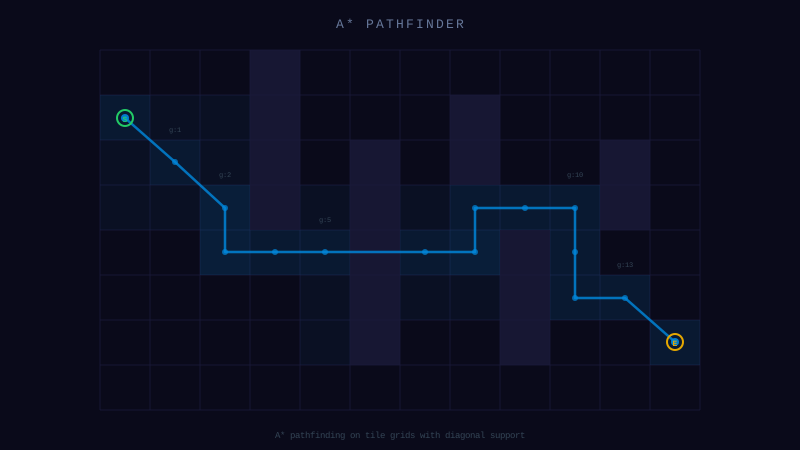
Description
The problem
Your enemies walk in straight lines and get stuck on walls. Your AI tried to implement pathfinding but the A* has bugs — enemies teleport, ignore terrain costs, or take bizarre detours. Getting A* right on a tile grid is trickier than it looks.
The solution
A clean, tested A* that works on any number[][] grid. You define terrain costs with a getCost(tileValue) callback — return undefined for impassable tiles.
- → findPath() — A* from pixel pos to any target tile
- → smoothPath() — removes redundant collinear waypoints
- → Multi-target — finds path to nearest goal (multiple targets)
- → Configurable costs — mud=3, road=1, wall=impassable
150 lines. Framework-agnostic. Manhattan heuristic, 4-directional.
Dependencies
None — zero external dependencies.
Technical Details
- Version
- 1.0.0
- Status
- Stable
- License
- MIT
- Size
- 3 KB
- Author
- Probably Playable
- Updated
- 2025-04-04
AI Integration Skill
Drop into .claude/skills/ — your AI handles the rest.
Pathfinder — Integration Skill
Use this skill when the user asks to "pathfinding", "A star", "find path",
"shortest route", "navigation", or "enemy movement AI".
WHAT IT DOES
A generic A* pathfinder for 2D tile grids. Given a start position, a grid of tile values, and one or more target positions, it finds the shortest path while respecting per-tile movement costs. Tiles can be impassable (walls, water) or have variable cost (roads are cheap, mud is expensive). Returns an array of pixel-coordinate waypoints, or null if no path exists. Includes an optional path-smoothing pass that removes redundant waypoints on straight segments.
REQUIREMENTS
- Framework: Any (Phaser, Three.js, vanilla JS, Node.js)
- Language: TypeScript or JavaScript
- Dependencies: None
- Files: 1 TypeScript file (~100 LOC)
INSTALL
- Copy the
findPathandsmoothPathfunctions into your project (e.g.,src/utils/Pathfinder.ts). - Import wherever needed:
- Provide your grid and a cost function.
- 4-directional only. This implementation does not support diagonal movement. Extending to 8-directional requires adjusting the
dirsarray and usingMath.SQRT2cost for diagonals. - Uses a simple array, not a priority queue. The open list is scanned linearly to find the lowest f-cost node. This is fine for grids under ~1000 tiles. For larger grids, replace with a binary heap.
- Grid is
grid[row][col], notgrid[x][y]. Row = Y axis, Col = X axis. This matches standard 2D array conventions. - Targets are pixel positions. They are converted to grid coordinates internally. The path output is also in pixel coordinates (tile centers).
- getCost must return undefined for impassable tiles, not 0 or -1. A cost of 0 would make the tile free (which might be intentional for roads), but negative costs break the algorithm.
- No path caching. Each call recomputes from scratch. If many entities need paths to the same target, consider a flow field instead.
`typescript
import { findPath, smoothPath } from './utils/Pathfinder';
`
INTEGRATION
Core Implementation
interface Point {
  x: number;
  y: number;
}

interface Node {
  col: number;
  row: number;
  g: number;
  h: number;
  f: number;
  parent: Node | null;
}

/**
 * A* pathfinding on a 2D tile grid (4-directional).
 *
 * @param startX - Start X in pixels
 * @param startY - Start Y in pixels
 * @param grid - 2D array of tile values (number[][])
 * @param targets - Array of goal positions in pixels
 * @param tileSize - Pixel size of one tile
 * @param getCost - Returns movement cost for a tile value, or undefined if impassable
 * @returns Array of pixel-coordinate waypoints, or null if no path
 */
function findPath(
  startX: number,
  startY: number,
  grid: number[][],
  targets: Point[],
  tileSize: number,
  getCost: (tileValue: number) => number | undefined
): Point[] | null {
  const startCol = Math.floor(startX / tileSize);
  const startRow = Math.floor(startY / tileSize);
  const rows = grid.length;
  const cols = grid[0]?.length ?? 0;

  // Convert targets to grid coords
  const goalSet = new Set<string>();
  for (const t of targets) {
    goalSet.add(`${Math.floor(t.x / tileSize)},${Math.floor(t.y / tileSize)}`);
  }

  const open: Node[] = [];
  const closed = new Set<string>();

  // Heuristic: Manhattan distance to nearest target
  function heuristic(col: number, row: number): number {
    let best = Infinity;
    for (const t of targets) {
      const tc = Math.floor(t.x / tileSize);
      const tr = Math.floor(t.y / tileSize);
      best = Math.min(best, Math.abs(col - tc) + Math.abs(row - tr));
    }
    return best;
  }

  const start: Node = {
    col: startCol, row: startRow,
    g: 0, h: heuristic(startCol, startRow), f: 0, parent: null,
  };
  start.f = start.g + start.h;
  open.push(start);

  const dirs = [[0, -1], [1, 0], [0, 1], [-1, 0]]; // N, E, S, W

  while (open.length > 0) {
    // Find node with lowest f (simple array scan)
    let bestIdx = 0;
    for (let i = 1; i < open.length; i++) {
      if (open[i].f < open[bestIdx].f) bestIdx = i;
    }
    const current = open.splice(bestIdx, 1)[0];
    const key = `${current.col},${current.row}`;

    if (goalSet.has(key)) {
      // Reconstruct path
      const path: Point[] = [];
      let node: Node | null = current;
      while (node) {
        path.unshift({
          x: (node.col + 0.5) * tileSize,
          y: (node.row + 0.5) * tileSize,
        });
        node = node.parent;
      }
      return path;
    }

    closed.add(key);

    for (const [dc, dr] of dirs) {
      const nc = current.col + dc;
      const nr = current.row + dr;
      if (nc < 0 || nc >= cols || nr < 0 || nr >= rows) continue;

      const nKey = `${nc},${nr}`;
      if (closed.has(nKey)) continue;

      const cost = getCost(grid[nr][nc]);
      if (cost === undefined) continue; // Impassable

      const g = current.g + cost;
      const existing = open.find(n => n.col === nc && n.row === nr);

      if (existing) {
        if (g < existing.g) {
          existing.g = g;
          existing.f = g + existing.h;
          existing.parent = current;
        }
      } else {
        const h = heuristic(nc, nr);
        open.push({ col: nc, row: nr, g, h, f: g + h, parent: current });
      }
    }
  }

  return null; // No path found
}

/**
 * Remove redundant waypoints on straight segments.
 */
function smoothPath(path: Point[]): Point[] {
  if (path.length <= 2) return path;

  const result: Point[] = [path[0]];
  for (let i = 1; i < path.length - 1; i++) {
    const prev = result[result.length - 1];
    const next = path[i + 1];
    // Keep point only if direction changes
    const dx1 = path[i].x - prev.x;
    const dy1 = path[i].y - prev.y;
    const dx2 = next.x - path[i].x;
    const dy2 = next.y - path[i].y;
    if (dx1 !== dx2 || dy1 !== dy2) {
      result.push(path[i]);
    }
  }
  result.push(path[path.length - 1]);
  return result;
}
Enemy Movement Example
// Grid: 0 = ground, 1 = wall, 2 = mud (slow)
const grid: number[][] = [
  [0, 0, 0, 1, 0],
  [0, 1, 0, 2, 0],
  [0, 0, 0, 0, 0],
];

const TILE_SIZE = 64;

function tileCost(value: number): number | undefined {
  if (value === 1) return undefined; // Wall — impassable
  if (value === 2) return 3;         // Mud — 3x cost
  return 1;                          // Ground — normal
}

// Find path from enemy to player
const path = findPath(
  enemy.x, enemy.y,
  grid,
  [{ x: player.x, y: player.y }],
  TILE_SIZE,
  tileCost
);

if (path) {
  const smoothed = smoothPath(path);
  enemy.followPath(smoothed);
}
Multiple Targets Example
// Find path to nearest exit (any of several goal tiles)
const exits: Point[] = [
  { x: 64, y: 0 },
  { x: 256, y: 320 },
  { x: 448, y: 160 },
];

const path = findPath(npc.x, npc.y, grid, exits, TILE_SIZE, tileCost);
// A* will find the shortest path to whichever exit is closest
CONFIGURATION
| Option | Type | Default | Description | |
|---|---|---|---|---|
grid | number[][] | *required* | 2D array where grid[row][col] is the tile value | |
tileSize | number | *required* | Pixel size of one tile | |
getCost | `(value) => number \ | undefined` | *required* | Cost function: return cost (>0) or undefined for impassable |
targets | Point[] | *required* | One or more goal positions in pixel coordinates |
API REFERENCE
| Function | Signature | Returns | Description | |
|---|---|---|---|---|
findPath | findPath(startX, startY, grid, targets, tileSize, getCost) | `Point[] \ | null` | A* path as pixel waypoints, or null |
smoothPath | smoothPath(path: Point[]) | Point[] | Remove redundant straight-line waypoints |
Point interface: { x: number, y: number } — pixel coordinates (path waypoints are tile centers).
GOTCHAS
This codon is provided "as is" without warranty of any kind, express or implied. Probably Playable assumes no responsibility for any damages, data loss, security vulnerabilities, or defects arising from its use. You are solely responsible for reviewing, testing, and validating this code before integrating it into your project. Use at your own risk.